源码实现-MobileNet

源码实现-MobileNet

本文整理 MobileNetV1 / V2 (Depthwise Separable、Inverted Residual)中与标准卷积的差异,并给出与常见实现思路一致的 PyTorch 极简模块,便于对照 timm 等源码阅读。

Contents


概述与传统卷积


传统卷积块常用组合:Conv + BN + ReLU(或同类激活)。

MobileNet 系列面向移动端与嵌入式场景,通过结构拆分显著降低计算量与参数量:

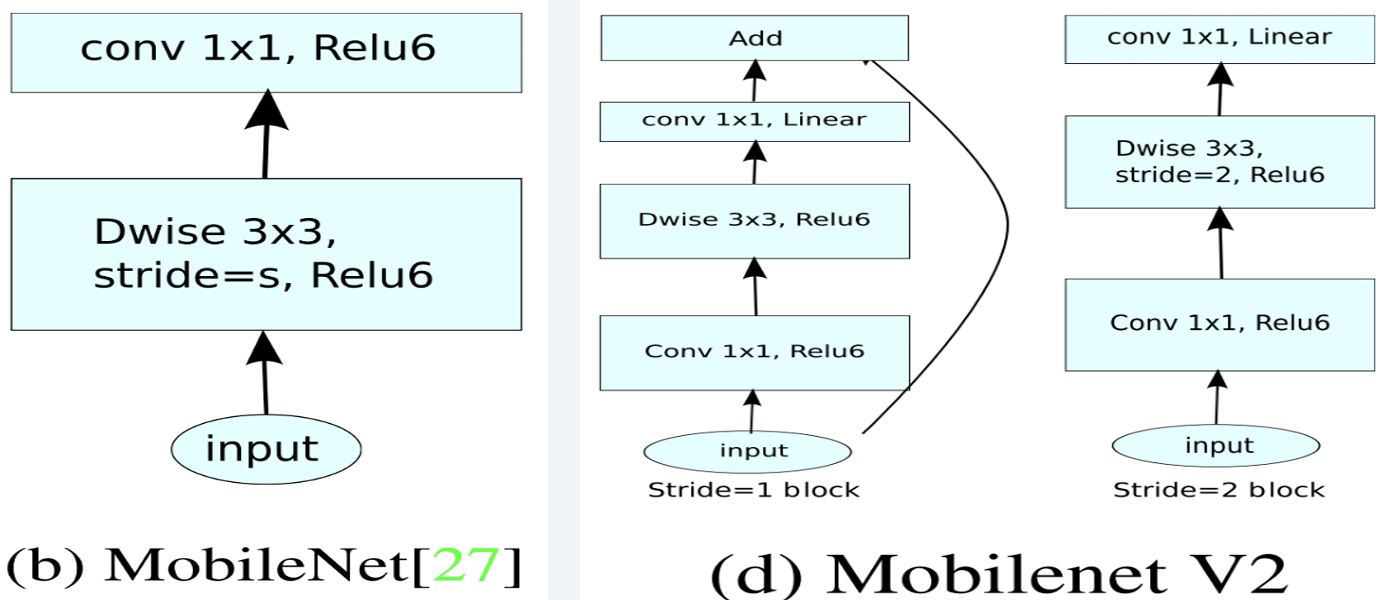
  • MobileNetV1:引入 Depthwise Separable Convolution,把标准卷积拆成 Depthwise(逐通道空间卷积) + Pointwise(1×1 通道混合),中间配合 BN 与 ReLU6;
  • MobileNetV2:在 V1 基础上使用 Inverted Residual(瓶颈倒置):先 扩张(expansion) → Depthwise → 投影(projection),并在步幅为 1 且输入输出通道一致时使用 残差相加;最后一个 pointwise 后通常 不再接 ReLU(线性瓶颈),以避免破坏低维表征。

MobileNetV1


对每个输入通道独立做空间卷积(groups = in_channels),再用 1×1 卷积做通道线性组合:

  • depthwiseConv3×3groups=in_channels
  • pointwiseConv1×1,输出期望通道数。

典型激活使用 ReLU6min(max(x, 0), 6),便于在低精度场景压缩动态范围。

MobileNetV2


与「先压缩再卷积」的残差瓶颈相反,Inverted Residual 在低维输入上先用 1×1 升高通道(expand),在高维空间做 depthwise,再用 1×1 压回低维(project)

  1. pointwise:1×1 + BN + ReLU6(扩张到 mid_channels,常为 in_channels × expansion);
  2. depthwise:k×k + BN + ReLU6,groups=mid_channels
  3. pointwise:1×1 + BN(一般 无 ReLU,线性瓶颈);
  4. stride == 1in_channels == out_channels,则 out += x

当 stride≠1 或通道变化时,不进行残差相加。

PyTorch 极简实现


下面是与上文结构对应的教学用模块名:DepthwiseSeparableConv(V1)、ConvDepthwiseConv(V2 倒置残差块)。对照可读性实现,forward 逻辑与常见开源代码一致。

import torch
import torch.nn as nn


class DepthwiseSeparableConv(nn.Module):
def __init__(self, in_channels, out_channels, stride=1):
super().__init__()
self.depthwise = nn.Sequential(
nn.Conv2d(
in_channels,
in_channels,
kernel_size=3,
stride=stride,
padding=1,
groups=in_channels,
),
nn.BatchNorm2d(in_channels),
nn.ReLU6(inplace=True),
)
self.pointwise = nn.Sequential(
nn.Conv2d(in_channels, out_channels, kernel_size=1, stride=1, padding=0),
nn.BatchNorm2d(out_channels),
nn.ReLU6(inplace=True),
)

def forward(self, x):
x = self.depthwise(x)
x = self.pointwise(x)
return x


class ConvDepthwiseConv(nn.Module):
def __init__(
self,
in_channels,
mid_channels,
out_channels,
kernel_size=3,
stride=1,
padding=1,
dilation=1,
**unused,
):
super().__init__()
self.use_residual = stride == 1 and in_channels == out_channels
self.conv1 = nn.Sequential(
nn.Conv2d(in_channels, mid_channels, kernel_size=1, stride=1, padding=0),
nn.BatchNorm2d(mid_channels),
nn.ReLU6(inplace=True),
)
self.depthwise = nn.Sequential(
nn.Conv2d(
mid_channels,
mid_channels,
kernel_size,
stride,
padding,
groups=mid_channels,
dilation=dilation,
),
nn.BatchNorm2d(mid_channels),
nn.ReLU6(inplace=True),
)
self.conv2 = nn.Sequential(
nn.Conv2d(mid_channels, out_channels, kernel_size=1, stride=1, padding=0),
nn.BatchNorm2d(out_channels),
)

def forward(self, x):
out = self.conv1(x)
out = self.depthwise(out)
out = self.conv2(out)
if self.use_residual:
return x + out
return out

工业实现里还会处理膨胀深度卷积、SE、分割头等细节;阅读 **timm** 中命名一致的模块更易对照论文与表格宽度倍数配置。

reference


  • Howard et al., MobileNets: Efficient Convolutional Neural Networks for Mobile Vision Applications(MobileNetV1)
  • Sandler et al., MobileNetV2: Inverted Residuals and Linear Bottlenecks
  • timm 中与 EfficientNet/MobileNet 系列共享的倒置残差参考实现:timm — InvertedResidual(_efficientnet_blocks.py

Comments

Your browser is out-of-date!

Update your browser to view this website correctly. Update my browser now

×